
Kixstart Property Brief | Perth rent versus buy
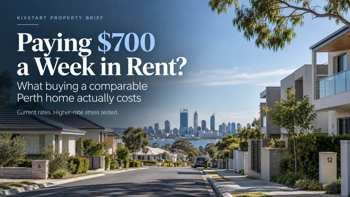
Perth renters have far more homes to choose from if they want to buy, but borrowing costs remain high. Kixstart Property tested 25 Perth property segments to see where buying an equivalent home is becoming financially competitive with continuing to rent.
Perth renters face an unusual housing market.
Finding a rental remains difficult. Yet buyers suddenly have far more homes to choose from.
REIWA’s Perth market snapshot recorded 7,755 properties listed for sale in the week ending 20 September 2026, up from 7,204 four weeks earlier and 2,929 in the same week a year earlier. Rental choice moved in the opposite direction. There were 1,974 properties available for rent, down from 2,083 four weeks earlier and 2,122 a year earlier.
That is about a 165 per cent annual increase in sale listings and a 7 per cent annual fall in rental listings. It does not prove that rental homes are being transferred into the sales market. It does show that buyers and renters are experiencing increasingly different levels of choice.
That raises an obvious question for someone paying $600, $700 or $800 a week in rent:
Would buying something similar now make financial sense?
Kixstart Property tested that question across 25 Perth property segments.
The answer is more complicated than comparing your weekly rent with a mortgage repayment.
More choice does not mean homes have become affordable
There is an important contradiction in Perth’s current market.
Buyers have considerably more choice than they had a year ago. Seller discounting has also increased. REIWA reported in June that about three in ten Perth houses were selling below their original listing price, compared with roughly one in ten during the tighter conditions of late 2025 and early 2026.
But that improvement in negotiating conditions has not fixed affordability.
The Housing Industry Association’s June-quarter 2026 Affordability Index put Australian housing at its least affordable level since HIA records began in 1994.
Perth recorded the largest deterioration among the capital cities over the year, with its affordability index falling 19.8 per cent. Higher interest rates combined with previous price growth have made mortgage servicing substantially harder even as market conditions have begun to soften.
A separate realestate.com.au affordability measure reached a similar conclusion nationally. A typical-income household could afford only 12 per cent of homes sold during 2025-26, the lowest share in the history of that index.
Cotality also estimated earlier this year that the household income required to service a median Perth house had risen by about $16,500 between January and May 2026 as higher rates combined with rising prices.
So Perth renters considering buying are facing two competing changes.
There are more properties to choose from.
But borrowing enough to buy one has become harder.
That makes the property type, purchase price and deposit increasingly important.
Buying is still generally more expensive month to month
At current borrowing costs, none of the 25 property segments Kixstart tested was cheaper to own month-to-month using a 10 per cent deposit.
Our modelling uses a representative 6.15 per cent owner-occupier principal-and-interest rate over 30 years and then tests higher-rate scenarios.
For context, advertised rates vary according to lender, loan-to-value ratio and borrower circumstances. At the time of modelling in early September 2026, Westpac advertised an online owner-occupier variable P&I rate of 5.99 per cent for qualifying loans at up to 80 per cent LVR.
Our ownership calculation also includes allowances for council rates, water charges, insurance, maintenance and strata costs where applicable.
For houses, the gap was often substantial.
A typical three-bedroom house in Rockingham, for example, had a purchase price around $820,000 against comparable rent around $600 a week in our dataset.
Under our assumptions, renting remained considerably cheaper than owning.
The same broad pattern appeared across many three-bedroom house markets.
So the fact that Perth now has more properties for sale does not automatically mean buying has become financially superior to renting.
Units tell a different story
The gap becomes more interesting when we look at some two-bedroom units, villas and townhouse-style properties.
In Belmont, our analysis used a representative two-bedroom purchase price around $592,000 and comparable rent around $762 a week.
With a 10 per cent deposit, estimated total ownership costs were about $3,900 a month.
Equivalent rent was about $3,300 a month.
Buying was therefore still roughly $600 a month more expensive.
But that is a considerably closer financial decision than many of the house comparisons.
Hamilton Hill produced a similar result.
A representative two-bedroom purchase price around $563,000 compared with rent around $695 a week. Estimated ownership cost with a 10 per cent deposit was about $3,686 a month, compared with rent of approximately $3,012.
Again, buying did not win on immediate cash flow.
But the difference was small enough to justify looking beyond the first month’s numbers.
A bigger deposit changes the calculation
At a 20 per cent deposit, the gap narrowed considerably.
Our Belmont example moved to approximately $193 a month more to own than rent.
Hamilton Hill moved to approximately $285 a month more.
That does not make buying automatically better.
It means the financial difference has become small enough that other questions become important.
- How long do you expect to stay?
- How important is tenure security?
- Does the property have good resale demand?
- What are the real strata costs?
- Can you comfortably absorb higher interest rates?
- How much of your available cash would buying consume?
- What else could that deposit have been doing if it remained invested?
Worked renter scenario: $700 a week with a higher-rate stress test
Consider a renter paying $700 a week, or about $3,033 a month. They are looking at the Belmont two-bedroom example used in our model, with a representative purchase price of $592,000.
A 10 per cent deposit would be $59,200. The buyer would also need settlement, inspection and moving costs, plus a cash buffer. Under our model, which includes the mortgage and allowances for council rates, water charges, insurance, maintenance and strata, the comparison is:
- at 6.15 per cent, estimated ownership cost is about $3,904 a month, or $871 more than the renter currently pays;
- at 6.65 per cent, estimated ownership cost rises to about $4,079 a month, a premium of about $1,046;
- at 7.15 per cent, estimated ownership cost reaches about $4,257 a month, or $1,224 more than the current rent.
The 7.15 per cent case is a stress test, not a forecast. Its purpose is simple: if the buyer cannot comfortably carry another $1,224 a month while retaining an emergency buffer, the purchase is too tight even if the property looks attractive.
The same test should be repeated using the buyer’s actual loan offer, the property’s real strata records and a genuine comparable rent. A citywide increase in listings creates more choice. It does not make an uncomfortable repayment safe.
First-home-buyer assistance helps with one problem, not every problem
Western Australia’s current first-home-buyer transfer-duty concession can materially reduce upfront purchasing costs.
For eligible transactions entered into from 7 May 2026, the WA Government increased the thresholds applying to the First Home Owner Rate.
The Australian Government’s 5% Deposit Scheme can also allow eligible first-home buyers to purchase with a smaller deposit without paying lenders mortgage insurance, subject to scheme and lender requirements.
These policies can materially reduce the amount of cash required to enter the market.
But a smaller deposit usually creates a larger mortgage.
That means someone can overcome the deposit hurdle while still facing a considerably higher monthly housing cost.
Those are two separate affordability questions.
What happens over ten years?
This is where the comparison becomes more interesting.
A mortgage repayment includes interest, but part of each repayment also reduces the loan principal.
Rent does not build property equity.
But a fair comparison also needs to give the renter credit for the money they did not put into a deposit, acquisition costs and higher monthly ownership expenses.
Kixstart therefore modelled several of the strongest markets over approximately five and ten years.
- mortgage principal reduction;
- mortgage interest;
- ownership expenses;
- rent escalation;
- buying and selling costs;
- the opportunity cost of the deposit;
- zero, 2 per cent and 4 per cent annual property-growth scenarios.
These are scenarios, not forecasts.
In Belmont, the buyer remained approximately $18,000 behind the renter after five years if the property experienced no capital growth.
After ten years, however, the buyer was about $23,000 ahead under our zero-growth scenario.
At 2 per cent annual capital growth, the estimated ten-year ownership advantage increased to about $149,000.
Hamilton Hill was approximately break-even after ten years under the zero-growth scenario and moved more clearly in favour of ownership under modest positive-growth assumptions.
Thornlie and Cannington required more help from either capital growth, time or a larger deposit before the ownership case became as strong.
The important point is not that prices must rise.
They may not.
The important point is that selected Perth markets can now approach long-term financial competitiveness without requiring an aggressive capital-growth assumption.
Principal repayment contributes to that result.
Strata can change everything
There is an important warning in these numbers.
Broad “unit” statistics can combine apartments, villas and townhouses.
Their ownership costs can be completely different.
A two-bedroom villa in a small complex with limited common property may carry relatively modest strata costs.
A similarly priced apartment with lifts, a swimming pool, underground parking and substantial shared infrastructure may carry thousands of dollars more in annual levies.
A looming special levy can change the calculation again.
So can building defects, waterproofing failures, poorly funded reserve accounts or expensive common-property repairs.
That is why an attractive purchase-price-to-rent ratio should be treated as a screening signal, not a buying decision.
Where the numbers currently look most interesting
Our current analysis identified two-bedroom properties in Belmont and Hamilton Hill as the clearest examples where the rent-versus-buy gap has narrowed.
Two-bedroom stock in Thornlie, Cannington and Midland also warrants closer property-specific investigation.
What these markets have in common is more important than the suburb names themselves.
- moderately priced two-bedroom stock;
- relatively high comparable rents;
- units, villas or townhouses rather than detached houses;
- purchase prices near first-home-buyer concession thresholds;
- properties where strata costs remain manageable.
For an eligible first-home buyer, an older villa or townhouse around or below $600,000 can therefore be worth investigating.
If it sits in a small complex, has reasonable strata expenses and has scope for sensible cosmetic improvement, the property may warrant further feasibility work.
That still does not make it an automatic purchase.
So should you keep renting or buy?
For most Perth markets we tested, renting remains cheaper today.
That should not be hidden.
And Australia’s current affordability evidence is a useful warning against interpreting increasing listings as meaning housing has suddenly become cheap.
It has not.
Perth affordability has deteriorated sharply.
Mortgage rates matter enormously.
But the decision is becoming closer in certain property types.
A renter paying around $700 a week should therefore avoid two assumptions.
The first is that buying must be better simply because rent feels expensive.
The second is that buying cannot possibly stack up because Perth property prices have risen.
Neither assumption is reliable.
The useful question is much more specific:
“I’m paying $X a week in rent and have approximately $Y available as a deposit. What would buying a genuinely comparable property actually look like?”
That comparison needs to include the mortgage, transfer duty, strata, council and water charges, insurance, maintenance, holding period, interest-rate risk and the amount of cash you would need to commit.
What would buying a comparable property actually look like?
Kixstart Property’s research and property feasibility work can help make the property numbers, renovation potential and practical trade-offs visible before a decision is made. Kixstart Property is not acting as a buyer’s agent through this service.
Methodology
Kixstart Property analysed 25 Perth property segments using suburb-level sales and rental evidence available in early September 2026. The citywide listings snapshot was updated to the week ending 20 September 2026; the underlying segment model was not re-run.
Current market evidence was checked against REIWA, the Reserve Bank of Australia, government first-home-buyer information and current lender pricing.
Ownership-cost modelling includes principal-and-interest repayments and allowances for council rates, water charges, insurance, maintenance and strata where applicable.
The baseline financing model uses a representative 6.15 per cent mortgage rate over 30 years. Separate scenarios test rates 0.25, 0.50 and 1.00 percentage points higher.
Five and ten-year scenarios include mortgage principal reduction, ownership expenses, selling costs, rent escalation, deposit opportunity cost and multiple capital-growth assumptions, including zero growth.
These calculations are research scenarios rather than financial advice or property forecasts.
Individual properties can differ materially from suburb medians. Actual finance terms, strata costs, council and water charges, building condition and transaction costs should be checked before a property decision is made.
Principal sources
- REIWA Perth Metro Market Insights
- REIWA Rental Vacancy Rates
- REIWA seller discounting analysis
- Reserve Bank of Australia cash rate
- HIA Housing Affordability Index
- realestate.com.au Housing Affordability Report 2026
- Cotality Monthly Housing Chart Pack
- RevenueWA First Home Owner Rate
- Australian Government 5% Deposit Scheme
This article provides general information and research only. It is not financial, lending, taxation, legal, valuation or investment advice. Individual circumstances and property-level costs can materially change the result. Check current information and obtain professional advice appropriate to your circumstances before acting.